Conceptual Orientation and Theoretical Positioning.
Over many years, I have sustained an engagement with psychoanalytic theory and dissociation studies. I approach these domains through the lens of systems psychodynamics, conceptualising psychic life as relational, dynamic, and internally organised. My research interest centres on the formation and development of identity, with particular attention to how representations of self are generated, organised, and transformed.
Representational Modalities and the Construction of Self.
Representations of self may take visual forms — including drawings, paintings, photographs, and collages — as well as word-based forms such as poetry, prose, plays, and narrative texts. Within this enquiry, such creative productions are understood as representational artefacts that give form to internal psychic configurations.
Psychic States, Relational Dynamics, and Meaning-Making.
These configurations such as ego-states, self-states, and role-states are conceptualised as complex internal psychic constructs, containing conscious lived experience alongside tacit and unconscious material. These states exist in dynamic, reciprocal relationships with one another and engage in ongoing internal discourse. Simultaneously, they remain in continuous interaction with the external world, which informs and reshapes internal meaning-making processes.
Through this relational activity, psychic states are understood to co-constitute one another within the psychic system. The quality and organisation of these internal relationships contribute significantly to the development of identity, the articulation of values, and the individual’s capacity for agency, realisation (to be in reality) and personalisation (to self-recognise), two critical charactoristics of a healthy psychic system.
Trauma, Disruption, and Dissociative Organisation.
Exposure to trauma and sustained anxiety disrupts the free-associative relational field between internal states. Prior to trauma, these states participate in a broad internal discourse that may be fluid or faltering, collaborative or conflictual, yet always remains active and self referencing.
Trauma fundamentally alters this internal ecology. It introduces paradoxical dynamics both within and between psychic states, resulting in processes of compaction, isolation, and defensive enclosure. Free association is curtailed, discourse diminished, and dissociation replaces relational exchange. Traumatised and dissociated individuals often exhibit de-realisation, a loss of a sense of location and de-personalisation, a loss of self-recognition. This shift marks a significant disruption in psychodynamic structure.
The psychodynamic analysis of this movement back from this dissociative structure to one of a free association of states related through story, narrative and representations of reengagement, constitutes the central focus of my doctoral research.
Creative Expression as Methodological and Integrative Practice.
To explore these psychic states and explore the process of reintergration, I developed an approach termed Creative Expression. This approach synthesises principles from creative arts therapy and expressive therapies and functions as both a methodological orientation and an exploratory practice.
Creative Expression facilitates the production of two and three-dimensional forms, the elaboration of personal narratives, and the emergence of re-authored accounts of self. The process is grounded in an arts-based, multimodal methodology driven by bilateral stimulation, supporting whole-brain and whole-mind engagement as a psychophysiological and psychic integrative process.
Re-Integration, Reflexivity, and Psychic Re-Occupation.
Multimodal representations draw upon multiple neural networks and are capable of holding complex mental spaces and lived experience. These representations exist in reflexive relationship with one another — revisited, reworked, and reinterpreted over time.
Through this process, the research explores how enclosed psychic territories may be re-occupied, how defensive structures may soften, and how internal states can reconnect and re-enter relational dialogue. This work attends to the conditions under which psychic integration becomes possible.
Knowledge Production and Situated Sharing.
Selected creative representations are shared on this page as part of this ongoing enquiry. This work reflects both a research trajectory and a personal commitment to creativity, reflexivity, and the exploration of lived experience.
Theoretical Explorer
Representational Images
Unconscious Inspiration Too.
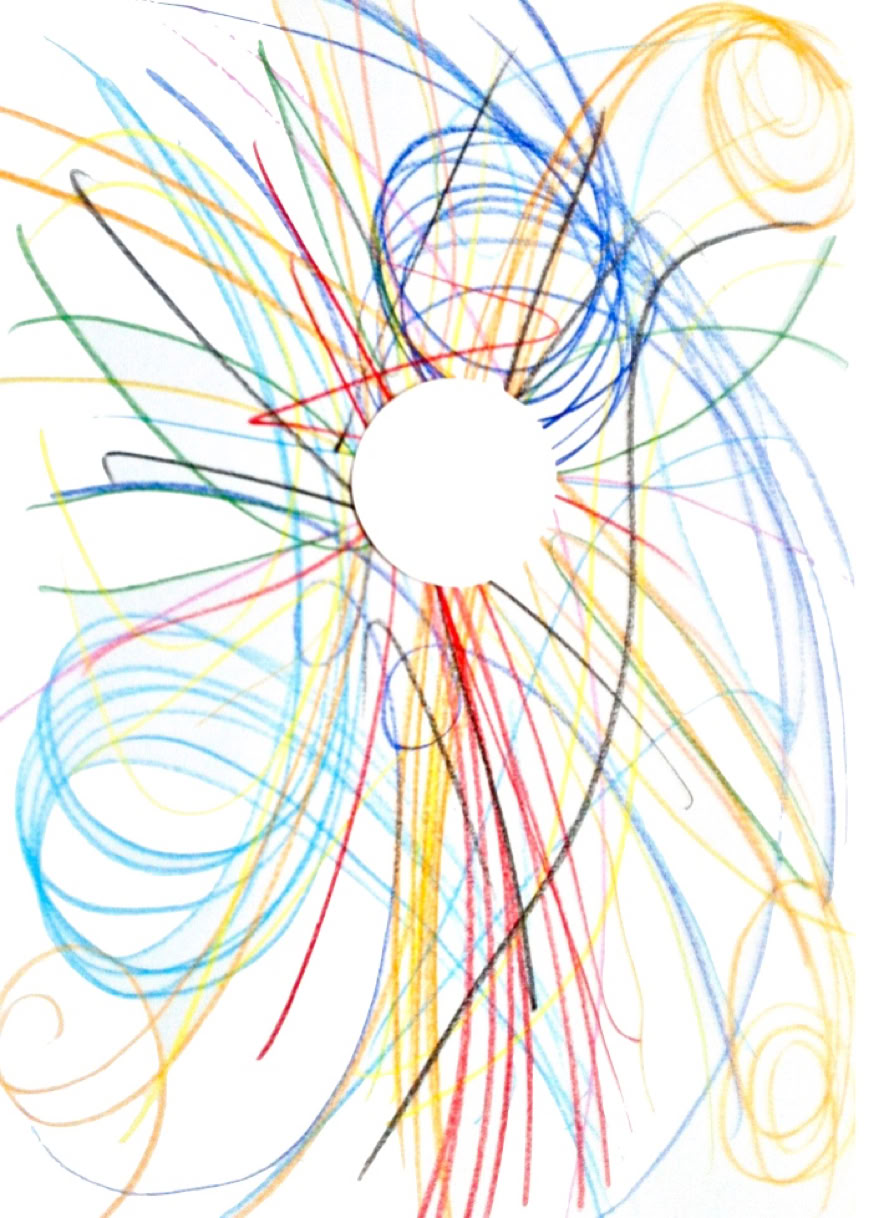
This work explores the concept of inspiration. I wanted to explore how images and thoughts emerge with a little help from Wilfred Bion. Behind this image is a second more conventional image. But this filtered image really captures the struggle to hold the first few moments of inspiration, that space between the known world and the imagination. I try to hold what is not yet in or of this world.


The Boundary of Conscious
That indefinable point where we come to see, to feel, to understand.
For creative people this coming to know is something we work/play with every day. As creatives as we seem to seek images, shapes, words, musical notes, choreographic movement that hold meaning for us and for the groups we live in.
Non-Figurative Self Portrait.
I am my values. They remain strong whatever shape I am in. I threw this artwork away, it seemed wooden, flat
and lacking dynamism. Dead.
I saw it scrumpled up on the floor and instantly I saw it anew. It is exactly the representation that felt right then as it
does now.

Am I walking
through life
…or Dancing
A Personal Research Environment
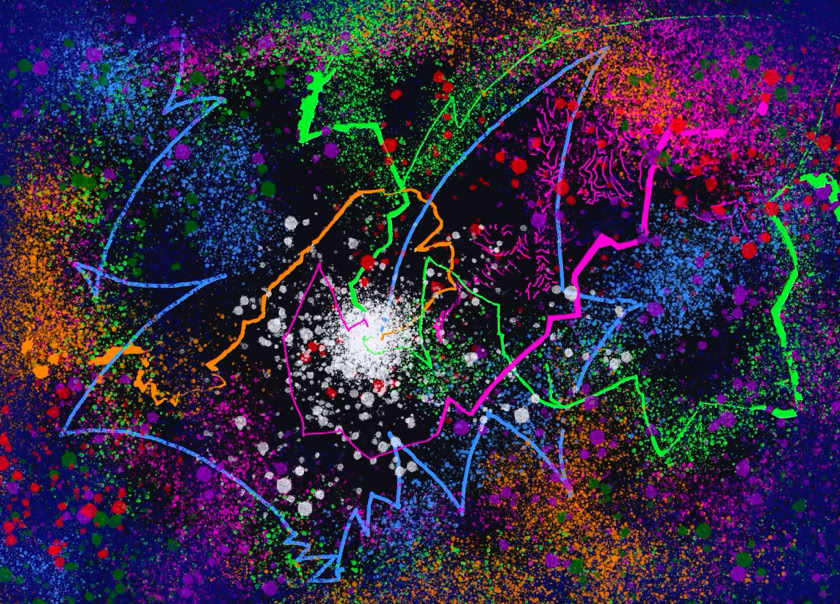
A snapshot of what a research environment looks like to me. Its full of exciting content. arranged out there in groupings of data or potential knowings. The sparkle and crackle of coming to know and to understand is also part of the process.
Non-Figurative Self Portrait.
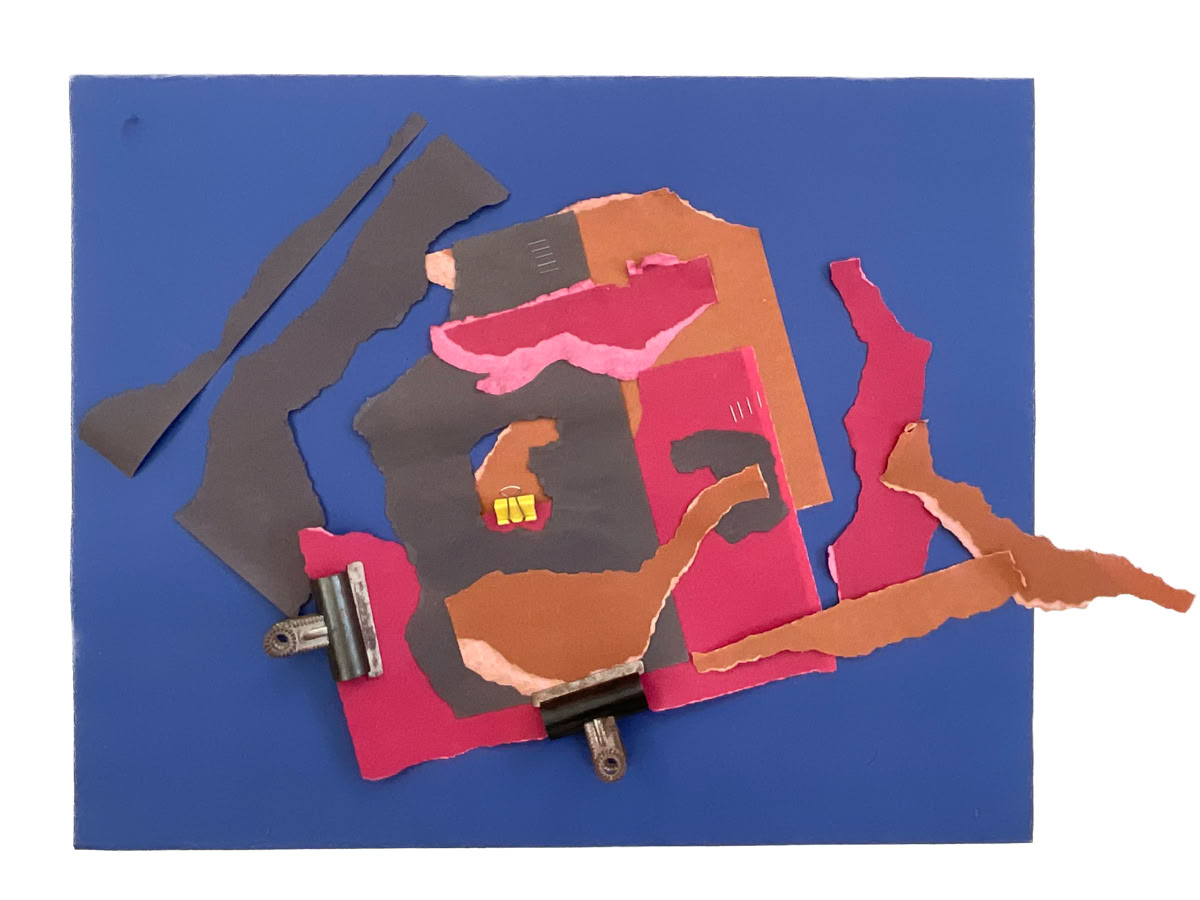
I am a collection of lived experiences, good and bad. In this representation I present a cohesive whole that is composed of many elements. Some in close collaboration, others more distant and maybe some even denied.
In this representation I push the concept of a single psychic entity introducing a space for a they/ him. I break out of my frame.